Monday, March 26, 2012

Seabirdskitchen visits Sustenio

Last weekend madame and I drove down to San Antonio to visit our good friend Chef David Gilbert (@beyondthekit on twitter) in his new adventure as the Executive Chef at Sustenio - the inspired restaurant at the Eilan resort in the North Western suburbs of San Antonio. And what a treat.


Even with all that magic, that wasn't the only high point! The resort and hotel are themselves fabulous. Great staff, wonderful place. But there's more. As many know, I am an avid baker. I was delighted when I was offered the chance to spend time with the brilliant bread maker Kelly Wiltshire in the pastry kitchen. The catch? Oh he starts at 4am. So at about 04:00 on the Saturday morning, I rocked up to the kitchen to find Kelly and get the training.
Intense. Fascinating to work with larger batches and the industrial sized Hobart mixers. Fresh yeast too.  So what did I learn (but come nowhere near mastering)?
  • That I am too nice to my dough. 
  • That shaping rolls has a rhythm and skill that I have yet to master, but am now on the way.
  • That doughs are more forgiving than I realized
  • The real importance of high gluten flours - and their ability to withstand jostling during transfer from making to baking
  • That you can (should) double bake artisinal breads to get extra crust
  • That it is even harder work than I expected!
  • That there is equipment I can only dream about 
Now That's a mixer!


 I also got to watch a Ernest, a pastry chef do some incredibly detailed work - and best of all let me taste some of the results. How do pastry chefs stay thin? beats me!


Tuesday, March 6, 2012

Caesar Salad

We had a hankering for a "proper" Caesar salad last week. No hairy fish, no gloppy dressing - just great Romaine with everything done just right. It's harder than it appears - even though the ingredients are simple.
Ingredients (Served 2 as main course)
2 garlic cloves + 1/4 t salt
3T pure olive oil
1/2 cup croutons (unflavored if buying - home made better)
1 egg
1 Romaine - pale leaves and heart only
4T Extra Virgin Olive Oil (best quality you can find
1T lemon juice
Few drops Worcesterhire sauce
1/4 cup coarsely grated Parmiggiano Reggiano
Coarse sea salt
Pepper
Method
Peel and mince the garlic, then sprinkle with salt and make a paste. Mix in 1T olive oil. Warm the other 2T of the pure olive oil in a pan, add the garlic paste and warm through. Toss in the croutons and warm through. Do not allow the garlic to brown as it will turn bitter.
Coddle the egg by placing the refrigerator temperature egg in a pan enough water to cover, bring to a simmer, turn off the heat and leave for 1 minute. Note if you are worried about salmonella and eggs, you may want to use a pasteurized egg for this.
Place the leaves in a large bowl, drizzle on the extra virgin olive oil. Toss. Add the lemon juice and Worcestershire sauce. Toss. Add the coddled egg and toss. The egg should emuslify into the lemon juice/oil. Add the croutons. Toss. Add the grated cheese. Toss. Serve the salad with some coarse sea salt and pepper to taste.

Sunday, February 26, 2012

Bacon and egg ice cream

The always amazing Chef Heston Blumenthal (he of the fat duck restaurant in Bray, England) makes bacon and egg ice cream. I was watching one of his programs and he showed how it is done. It looked pretty straightforward - and by doing it table side it has a definite wow factor. Well it isn't actually done table side, but the final freezing is - using dry ice.
Now dry ice is cold and potentially nasty stuff. It is carbon dioxide (CO2), and so you don't want it in a confined/airtight space. It comes in a solid block. It goes straight from solid to gas without going through a liquid phase. That means if you seal it up, the gas pressure build up will cause it to explode/ It is incredibly cold. You will get frostbite if you handle it wrong. In other words consult an expert before trying this at home.
Ingredients 
1 lb smoked bacon
1 1/4 pints (US pints or 1 Imperial pint) of WHOLE milk
10 large egg yolks - make meringues with the whites?
1/3 cup of maple syrup. (Chef Blumenthal's recipe uses sugar, but I wanted the maple flavor)
2T dried milk powder.
2 lbs dry ice
Method
Cook the bacon - I did it in the oven for 15 minutes at 425F.

Drain the bacon on paper towels. Cut into small pieces and infuse into the milk. Let stand in the fridge for at least 12 hours - preferably 18.
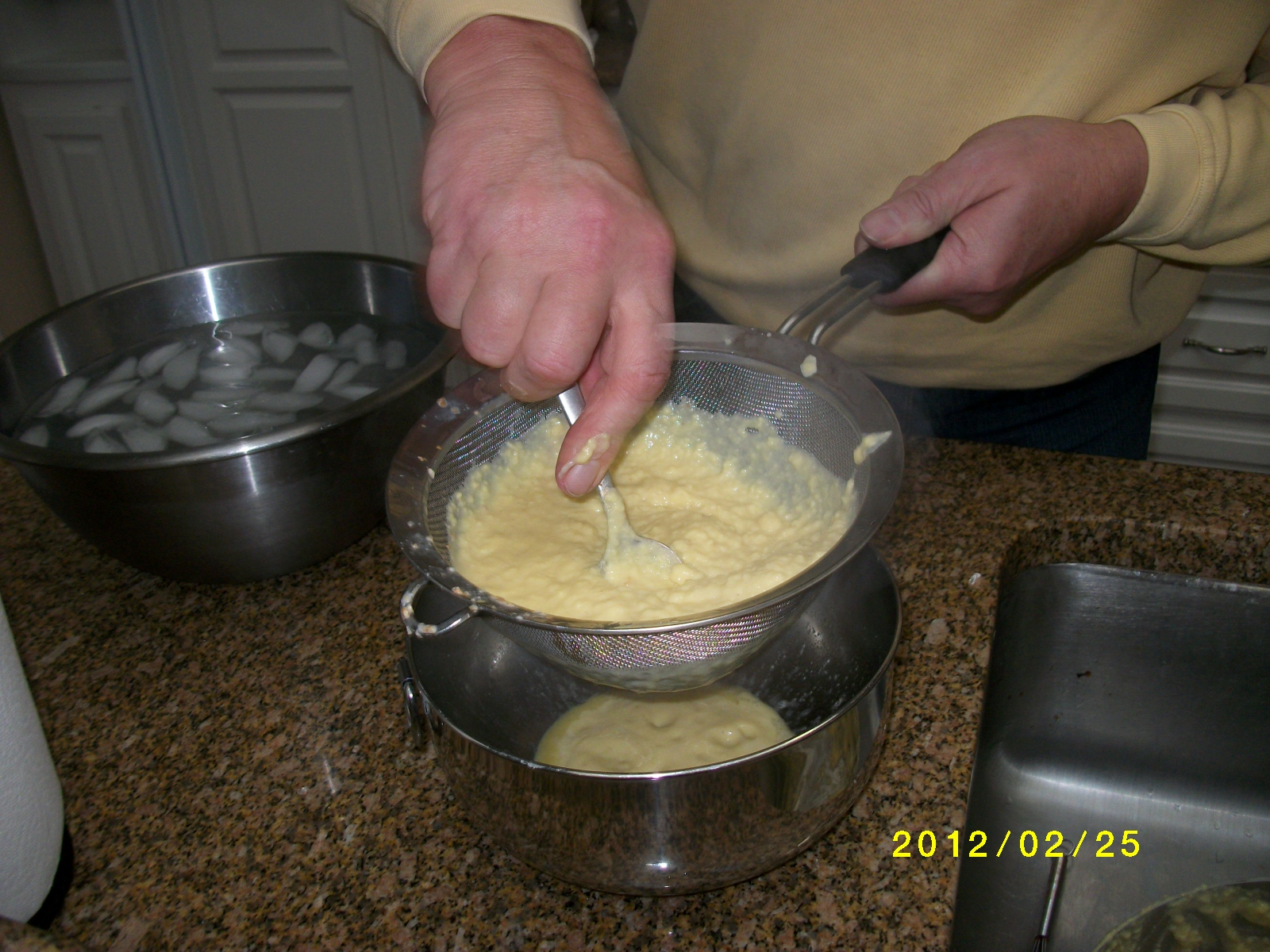
When the time comes to make the ice cream base, heat the milk/bacon mixture + the milk powder in a saucier until almost boiling. Temper the egg yolks with a little of the hot milk. When the yolks are tempered, strain the hot milk onto the eggs, whisking it in.
Discard the bacon. return the custard base to the saucier and heat slowly until thick (175F), stirring continuously. It will thicken and coagulate. Don't worry if it looks a bit like scrambled eggs at this stage - but do not allow to become solid!
Strain into a bowl, and immediately cool in an ice water bath. 


Refrigerate until ready to do the theater.
Serving
This dish was served with melba toast triangles

and a little maple syrup garnish. To freeze the ice cream, pulverize the dry ice in a plastic bag until it is a very fine powder. take care to wear gloves and safety goggles. Dump the dry ice into the custard base and stir like crazy with a metal spoon. The ice cream will freeze instantly and be very smooth in texture.

Soup and Sandwich

This course was the "lunch" course of the Day in Dinner party. It was the soup course, but like everything at the party, it was to have a slight twist. The soup was a simple tomato/roasted red pepper soup. The twist was the sandwich. With the soup you don't have to be precise about the size of the vegetables - it is going to be blended and strained so it is completely smooth.
Ingredients  - Soup
2 red bell peppers, left whole
2T vegetable oil
2 oz butter
1 large onion (I used yellow) minced
1 shallot minced
3 cloves garlic smashed
3T all purpose flour
1 large and 1 small can of whole tomatoes
2 cups chicken stock
3 sprigs of thyme
salt/pepper to taste
A few drops of extra virgin olive oil for serving
Sea salt crystals
Method - Soup
Heat the oven to 450F and roast the peppers until the skin is well charred (about 45 minutes). Meanwhile heat the oil/butter gently until hot but not brown. Add the onion, shallot, garlic and sweat gently. Do not allow any color to form.
Place the tomatoes into the blender and pulse quickly to break up the larger pieces. It is better to this than to but crushed or sauce tomatoes. This way they are less metallic tasting. Also if you are lucky enough to have some home canned tomatoes (as we were), they will almost always be whole.
Once the onion, shallot and garlic have softened, add the flour to the pot and stir to coat, and make a light roux. Add the tomatoes, stock, thyme to the pot. Stir to incorporate. Peel and roughly chop the roasted peppers (having removed the seeds), add the peppers to the pot.
Bring up to a simmer - gently to avoid sticking. Simmer for about 35 - 40 minutes stirring occasionally.
Puree the soup in the blender in several batches. Do this while it is hot - make sure you place a kitchen towel over the blender while doing this. You do not want hot tomato soup flying around the kitchen!
Strain the soup using a fine strainer and discard anything that remains in the strainer.
Chill overnight to allow the flavors to develop. Reheat when ready.
Ingredients - Sandwiches
16 oz Parmesan cheese - grated finely. Use the highest quality you can
6 oz fresh goat cheese
A good handful of fresh basil leaves
2T milk (may not be needed if the goats cheese is soft and creamy)
1t sherry vinegar
1t extra virgin olive oil
Method - Sandwiches
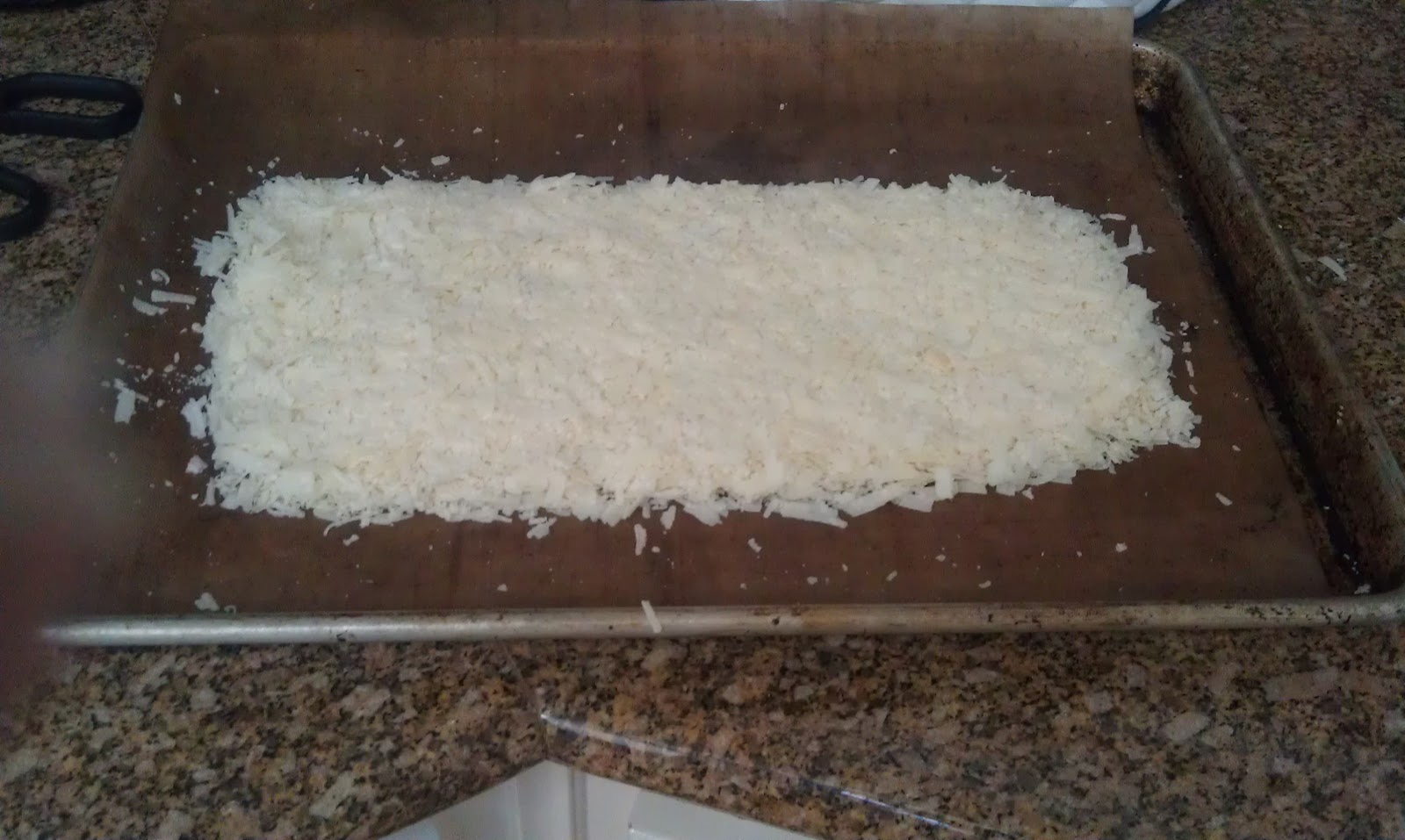
Make Parmesan tuiles by spreading the Parmesan cheese on a baking sheet
and baking in a 475 degree oven until it is melted and bubbling. (3-4 minutes). Allow to cool a bit. While still flexible (they do become crunchy eventually), cut them out into the shapes you want. I used a 1" ring cutter. One guest remarked that they looked like Communion Wafers.
When ready to make the sandwiches, form the filling pr processing the cheese, basil, milk (if needed), vinegar, oil until a smooth green paste is formed. There is no need for salt because the tuiles have enough salt for the whole sandwich. To make the sandwiches spread a little filling on one tuile and top with another.
Serve alongside the soup.

Butter Rosemary Almond Biscuits and coffee flavored vodka


These biscuits (cookies) are a variant on a recipe from my grandmother, handed down to me by my mother. So when I was last in England talking to her, I asked whether she made them by the "creaming method" or whether she made them like pastry. She also told me to use "proper butter" not the unsalted stuff! I ignored that admonition, but added salt anyway!
In the first post on the subject, I had assumed the creaming method, but 2 weeks ago, she corrected me and said that she always makes them like pastry. So for a Day in Dinner I made them like pastry. I also increased the rosemary slightly to get a bit more flavor.
Ingredients - Biscuits
4 oz powdered (icing) sugar
6 oz all purpose flour
4 oz slivered almonds, toasted
a pinch of salt
2 T rosemary leaves
8 oz cold unsalted butter - cut into 1/2 inch cubes.
Method - Biscuits
Place the flour, almonds, salt, sugar, rosemary into the food processor. Pulse several times until the almonds are ground finely and well incorporated. Add the cubed butter and pulse to incorporate. Continue to pulse until the dough comes together into a single piece. Don't overmix as you will end up with too much gluten.
Turn the dough out, form into a disk, wrap in cling wrap and place in the refrigerator for at least 30 minutes, up to a couple of hours.
Heat oven to 350F
Roll dough out into about 1/8in to 1/4 in thickness. Cut into 1in rounds.
Bake on a lined cookie sheet for 7 minutes, turn the temp down to 325 and bake until brown (another 7 mins or so). Rotate the pan when you change the temp.
Allow to cool on a wire rack.
Ingredients - Coffee Infused Vodka
2 Cups good quality vodka - we use Tito's because it is the nearest we can find to locally made.
2T Roasted coffee beans ( medium/dark roast works best).
Method
Pour the vodka over the coffee beans in a glass bottle. Leave to steep at room temperature for at least 2 weeks, turning occasionally. When the vodka is the color of  Scotch whisky, place the bottle in the freezer. It will keep almost indefinitely. You do however want to drink it very cold.
Serving
Serve the vodka in chilled vodka glasses (1 oz per person) with three coffee beans in each glass, accompanied by 2 or 3 of the biscuits.

Coffee and Baileys Gelee

For the "Day in Dinner" event, we made a coffee/Baileys gelee. A simple 2 level composition with a drop of cream on top. The trick is to make the gelees separately pour the bottom (in this case the coffee) first before it has started to set. Allow it to set up, and then very gently add the second.
Ingredients - Coffee Gelee
1 pkt gelatine
1/2 cup cold water
3 t plain sugar
2 cups of strong coffee (double strength, carefully filtered)
Method - Coffee Gelee
Bloom the gelatine in the cold water. Brew the coffee - make it double strength. Ad the sugar to the coffee and make sure it is very hot. Add to the bloomed gelatine and stir until combined. Place in an ice/water bath to cool, but not set. Put some of the coffee into a demitasse and refrigerate until set. About 3 hours.
Ingredients - Baileys Gelee
3/4 pkt gelatine
1 oz cold water
5 oz boiling water
8 oz Baileys Irish Cream
Method - Baileys Gelee
Bloom the gelatine in the cold water. Add the boiling water followed by the Baileys Irish Cream. Stir to combine. Chill in an ice/water bath until cold but not set.
Assembly
Once the coffee has set, use a pipette, place a thin layer of the Baileys gelee on top of the coffee. Take care not to disturb the surface of the coffee.

Chill until set and ready to serve. Again, with a pipette place a drop of cream into the center of the Baileys.

Day in Dinner


We thought it would be fun to do a dinner where each course comes from a different meal - with a twist, of course. This was described to the guests as an experiment in tastes, temperatures and textures.
So after some pretty intense menu planning, and testing we decided upon the following:

The event was a great success. The wow factor of the bacon/egg ice cream really got people talking. Thanks to Heston Blumenthal for the inspiration. The recipes for the various dishes are in individual blog postings. The cooking of the oxtails is shown here. However we served it differently, so I will describe that in the appropriate posting.
Plates were cleaned! One guest asked us all to close our eyes so he could lick his plate. 
I had learned some terrific lessons from my very good friend Chef David Gilbert. 
  • Keep an area aside for plating/serving - we added a picnic table to the kitchen for this.
  • Sous vide cooking can make food incredibly rich, tender, tasty with little risk
  • Make everything, using great ingredients
  • Don't be afraid 
  • Keep the work areas clean
Working alongside him for the dinner theater was an eye opener. So, as is often the case when stretching myself in the kitchen, I like to channel the "Little Fella". Thanks Dave - and thanks for the gear!

Monday, February 20, 2012

Oxtails

We have a rather inventive dinner coming up. It's called "a day in dinner", where each course comes from a different meal/time of day. The course corresponding to dinner is a sous-vide oxtail. On the night it will be served with celeriac puree and bitter greens. I did think it might be a good idea to try it out before actually serving it - especially as it takes 3 days to cook. Like many things sous vide, it is pretty straightforward - as long as someone gives you a clue. I wanted some 5-spice flavorings on this - they go so well with the richness of the oxtails, but how much?
Ingredients
2 t Szechuan peppercorns
1 t whole cloves
1 t pink peppercorns
4 whole star anise
1" piece of cinnamon
2 t salt
1T vegetable oil
2 lb oxtail (1 whole oxtail  of variable size)
3 leeks chopped roughly
1T vegetable oil
6 oz linguine
Method
Toast the Szechuan pepper, cloves and pink peppercorns in a hot skillet until fragrant. Allow to cool. Grind finely together with the star anise and cinnamon. Sieve the ground spices into the 1T of vegetable oil. Add the salt. Coat the oxtails in the oil/spice/salt mixture and double seal in a vacuum bag. Cook at 55C for 24hrs in the circulator, and a further 48 hrs at 70C.
Remove, chill and refrigerate.
Empty the contents of the bag into a saucier and start to reheat, melting the juices. Saute the leeks and when slightly browned, add the pan juices, stirring to combine.
Cook the pasta. About 5 minutes before the pasta is cooked, sear the oxtails on a hot skillet. Serve the oxtails over the pasta with the leek/sauce drizzled around.
The spicing was just right - cutting through the richness of the meat nicely. Of course the bottle of M. Chapoutier Chateau Neuf du Pape 2006 didn't do a lot of harm either!
And, oh yes. This does get the "we can serve this to people" accolade from Madame. Just as well really because we are going to anyway!

Wednesday, February 15, 2012

Butter-Almond_Rosemary biscuits

These cookies (biscuits in England) are in preparation for a party in a few days. We made them as a test, and sent them to school with Madame. Apparently they were a hit - the recipe was demanded. If I didn't post it, she would be held hostage until I did. Since I want to see her again, I figured I had better do it!
Ingredients
1/2 lb unsalted butter at room temperature
pinch of salt
4 oz confectioners sugar
6 oz AP flour
4 oz almonds toasted and ground into flour
1T fresh rosemary, minced fine

Method
Cream the butter/salt/sugar together until it is light and creamy. Add the flour, almond flour and the rosemary. Mix until it just comes together. Refrigerate for 30 minutes.
Heat oven to 350F
Roll dough out into about 1/8in to 1/4 in thickness. Cut into 1in rounds.
Bake on a lined cookie sheet for 7 minutes, turn the temp down to 325 and bake until brown (another 7 mins or so). Rotate the pan when you change the temp.
Allow to cool on a wire rack.

Sunday, February 12, 2012

The Chicken Breast Search Continues

Part of the inspiration for the sous vide experiments was to see if boneless, skinless chicken breasts could be made edible. A difficult challenge - usually they are tasteless, tough dry. Brining is an option, but still they are just plain difficult to do. Browning them, hoping for some good Maillard reaction flavors is possible, but futile. So with despair in my heart I reached for the circulator. In previous posts I mentioned the various experiments. Today's was to see what happens when cooked with a sauce.
Of course, given what I put in the sauce, the fat under the chicken skin would have hardly made any difference. The reason? heavy cream! Yes, this dish had a cream sauce placed into the bag with the raw chicken, and then cooked in the circulator at 71C (160F) for 4 hours. It got the "we can serve this to people" appellation, so I guess it came out OK!
Ingredients
1T butter
8 oz White mushrooms - sliced
2 large shallots - minced
5 sprigs thyme
3/4 cup whipping cream
salt/pepper
2 whole chicken breasts patted dry
Method
Heat the butter in a large skillet until the foaming has subsided. Add the minced shallots and stir quickly. Add the mushrooms and thyme sprigs. Salt and pepper the contents, and then cook down until most of the water has cooked out of the mushrooms. Add the cream to the hot pan and bring back to nearly a boil.
Place the chicken breasts in a vacuum bag, cover with the cream sauce and pump out the air. Place in the circulator at 71C for 4 hours.
If eating immediately, serve over simply cooked rice with some colorful (peas and carrots, for example) vegetables on the side.
Otherwise plunge in an ice bath to chill the bag, and place in the freezer. Thaw in the fridge, reheat - taking care to ensure that the chicken is heated all the way through. Serve as above.

Friday, February 3, 2012

Sous Vide vegetables

With the sous vide experiments in full swing, it was time to turn attention to vegetables. I was inspired to do this when Chef Gilbert and I worked on this dinner together. There we had cooked parsnips sous vide and finished them in the oven - so why not other veg too?
The whole sous vide experiment is, for me, a way of making good stuff, freezing some and reheating/finishing when madame gets home from work. Think boil in the bag but with fresh, wholesome, natural ingredients.
Ingredients (for 4 portions)
4 leeks, white and light green parts only washed very thoroughly
2 fennel bulbs, quartered
8 medium carrots cut into batons 1"x1/4"x1/4"
4 red (sweet) peppers
1t coriander seed toasted and ground fine
1/4t cardomom seed toasted and ground fine
2t whole cumin seed toasted and ground fine
4 pieces of lemon grass
1 1/2 inch piece of fresh ginger, grated
1t vegetable oil
Salt/pepper as desired

Method (Sous Vide)
Set the circulator to 80C (175F).
Coat the vegetables lightly with oil and rub in the spices. Portion the vegetables into 2 gallon vacuum bags and pump out the air. Double seal the bags.
Place the bags in the circulator for 3 hours. Remove, plunge into an ice bath to cool. Freeze if desired.

Method (Finishing)
Thaw the bags (if previously frozen). Heat the oven to 375, place the thawed vegetables onto a sheet pan, and heat through in the oven, taking care not to allow the leeks/fennel to dry out. Serve piping hot with salt/pepper as desired.

Comments
The carrots were a little to dried out/woody. The oven really caused them to lose to much liquid. The other vegetables were excellent. tender, cooked through, strongly flavored. And best of all really simple to make.

Tuesday, January 31, 2012

Beautiful Bok Choi

On Saturday, a group of us went to the Coppell Farmers' market. A bitterly cold day - the brave folks selling their wares were all shivering - but it seemed like good turnout. I certainly hope so for all who make a living producing really wholesome ingredients and foods. One stop was at my good friend Marie Tedei's stall. She had a couple of varieties of bok choi, some mixed salad leaves and arugula. All picked the day before, so lovely and fresh. I bought some bok choi and then the question, what to do with it? I wanted to preserve its wonderful bitterness and somehow turn it into the star of an evening dinner with Madame.
I have also been watching Heston Blumental's series "how to cook like Heston" on the UK's Channel 4. One episode was dedicated to eggs. I wanted to try his method of egg poaching. Now Chef Blumental may be able to put his hand up a chicken to get the freshest possible eggs. I haven't found any chickens close enough, so am having to rely on local producers for eggs of indeterminate age.
In the fridge there is (was!) some guanciale, so I could see the makings of a dish of lightly braised bok choi with guanciale and a couple of poached eggs nestling on top.
So that's what we had.
Ingredients
3 oz guanciale cut into lardons
1 head bok choi - white and green parts cut into large bite sized pieces, thoroughly rinsed
4 large eggs
A few drops of hot sauce
A few drops of vinegar - I used sherry vinegar
Pepper (and maybe salt - depends on the salitiness of the guanciale) to taste
A few croutons
Method
Gently cook the guanciale in a large skillet until all the fat has rendered and the meat has become firm and slightly crisp. It goes not crisp up like bacon does. Meanwhile rinse and drain the bok choi, and cut into bite sized pieces. No need to dry thoroughly. Put a deep pot of water onto the stove, side a plate into the bottom to protect the eggs from the heat of the pan and heat to a gentle simmer (180F or so).
With about 5 minutes to go before you want to serve the dish, drain all of the fat from the skillet and then put the bok choi in, stir, add a few drops of hot sauce and cover. Poach the eggs in the simmering liquid - about 4 minutes - until the whites are firm, but the yolks are still runny.
When the bok choi is cooked add the vinegar, toss and then spoon some in a mound inside a warmed bowl, taking care to drain it first. Add a few croutons and top with the poached eggs. Grind a little pepper and serve immediately. The accompanying wine was a Mulderbosh 2010 Chenin Blanc.

Thursday, January 26, 2012

Chicken with tarragon

As part of the experimentation with sous-vide cooking, I laid out some goals and the beginning process. Here's the link to that first post.

One of the goals was to see if there was a way to make boneless, skinless chicken breasts edible. The jury is still out, but the method shows promise.

What was really strange about this dish was how much liquid there was in the bag at the end (making us worry about how dry the chicken might be), and yet how moist and juicy the meat was. I am sure a food scientist can help with this conumdrum.

The dish was not an unqualified success, the chicken was rather mealy in texture. Taste was fabulous, but it was definitely soft. I think it is worth repeating the experiment, but maybe leaving it in the circulator for less time.

In any case here is what I did.

Ingredients
2 boneless skinless chicken breasts
Grape seed oil to coat the chicken
Salt/pepper - a small amount just to season
2 bunches of fresh tarragon

Method
Set up the circulator for a temperature of 160F (71C). Rub the chicken breasts with oil and then salt/pepper lightly. Place in vacuum bag and pack in the tarragon. Seal the bag as usual. Wait for the circulator to come to temperature. Slide the sealed bag into the circulator and leave to cook for 4 hours.
Take out of the circulator, plunge in ice water (still in the bag) until cold. Then freeze in the bag.
To reheat, give it abut 2 minutes in the microwave (still in the bag if you dare - but the bag will puff up and possibly explode). It may be wise to vent the bag before microwaving.

Slice on the diagonal and serve over salad.

Future Changes
Cook in the circulator for 2 hours instead of 4. It seems as if the tenderizing effect of sous vide cooking can make it go further than one would like. Otherwise, just keep doing it!

Monday, January 16, 2012

The sous vide lamb chops

For those who have been following the bouncing ball, you will know that I am in the sous-vide stage of life. I was lent a very high quality circulator and am going through the learning cuve that everyone else has been going through for a while.
Yesterday I made some lamb chops - coated with a mint/garlic/salt/oil paste and cooked sous vide for about 6 hours at 50C. Tonight I cracked open on eof the bags, and Madame and I had them for dinner. Success!!!

Ingredients
6 lamb loin chops - weighing 4-6 oz each
1/4/ cup packed mint leaves
1 small (3 inch) rosemary sprig - leaves only
3 cloves garlic
1/2 t salt
1T vegetable oil

Method
Pound the salt, rosemary, mint leaves in a pestle and mortar, adding oil to make a thick paste. Coat the chops with the paste. Seal the chops into 2 vacuum bags (3 chops/bag). Set the circulator to 50C (122 F) and submerge the bags. Cook for 6 hours in the bags.
Remove the bags from the circulator and refrigerate still in the bags.
When you wish to eat the chops, open the bag and sear the chops until the internal temp is 55C 130F (or more according to taste). This should take around 10 minutes on a medium hot skillet.
leave the chops to rest while assembling the salad.

Tasting notes
We served these chops with a Hahn GSM and a salad made with spring mix, olives, tomatoes, peppers, apple and avocado. Dressing was a simple tarragon vinaigrette made with sherry vinegar.


Yes this did get the highest Madame accolade, "We should serve this to people".

Sunday, January 15, 2012

Sous Vide Part 1 Chicken Beef Lamb and Pork

In this posting, I am laying out those items I plan to do in the first week or so of the grand sous vide experiment. Madame and I went shopping for:
  • Boneless, skinless chicken breasts
  • Pork ribs
  • Lamb chops
  • Beef sirloin
  • Leeks, peppers, celery
These are going to be turned into:

Chicken:
  1. mushrooms, onion, cream, rosemary, thyme, salt, pepper
  2. onion, fennel, indian spices, salt, pepper
  3. ginger, kaffir lime, coconut milk, lemon grass, salt, pepper
  4. cumin, coriander, star anise, cinnamon, clove, hot pepper sauce, salt, pepper
  5. tarragon, salt and pepper
Pork Ribs
  1. home made bbq sauce (ketchup, fish sauce, brown sugar, paprika, molasses, cumin ++)
  2. fish sauce, lime (juice and zest) shrimp paste, mirin, palm oil, szechuan peppers
  3. apple, calvados, cider vinegar
Lamb chops
  1. mint, garlic, salt pepper, trace of grapeseed oil
Sirloin (prime)
  1. salt, pink pepper corns, trace of oil
Vegetable Medley
  1. leeks, peppers, fennel, carrots, basil,
here's hoping that at least some of these will come out well. The chicken will be set to cook at 65 C. The lamb and the beef at 50C. The pork at 60C. The vegetables at 80C. Since the dishes will be finished later (sauced dishes by reheating, non sauced dishes by searing), the final temperatures should come out properly, and in line with the FDA guidelines in the USA. The vegetables should concentrate their sweetness too, by finishing in the oven.
These dishes will all be frozen, and then brought out as dinners at various times this winter/spring. If I have to travel, then I want to make sure that Madame has tasty/nutritious items.
Subsequent postings will detail the experiments.


The Sous Vide Experiment

My good friend David Gilbert has changed jobs and is gradually moving his belongings to San Antonio - to be the Executive Chef at the luxurious Eilan hotel. I managed to persuade him to loan me his water bath and circulator so I could try to do a bunch of sous vide cooking. I know he will want the equipment back as soon as he has some breathing room, so I need to work fast.

The challenges that I wish to undertake are:

  1. What will it take to make chicken breasts tasty?
  2. Can sous vide cooking do a good job with duck confit?
  3. Fish? - A huge topic all on its own. But I can think of several fun things to try - just like any other protein.
  4. If I precook a bunch of interesting stuff sous vide, can I freeze it, and then finish the cooking (sear or whatever) at a later date?
  5. What happens if I sous vide cook things with a sauce around them? Do sauces "make themselves" this way?
  6. What effects do various flavouring agents (especially herbs) have on the taste of the ingredients?
  7. What about vegetables? - We had some excellent parsnips at this event , so it made me wonder what would happen with other root vegetables.
  8. Eggs - lots of them. Eggs cooked in the circulator are fantastic. The trick is peeling the buggers afterwards. How long can a circulator cooked egg keep?
  9. More normal/conventional things - like cooking nice cuts of beef and searing them.
  10. What happens to cheese in the vacuum bag? - I suspect that nothing good will happen, but I have no idea! Temperature will be critical.
  11. Using the circulator quite cool as a rapid defrost mechanism. The trick of defrosting in cold tapwater is fine, but wasteful of water.
I am sure that many have tried these things before, and I could look up what they have done. But it is so much more fun to experiment. That's the nice thing about working from home - I can set and forget, leaving the circulator to do its thing while I am wrestling technology alligators to the ground.

Tuesday, December 6, 2011

The Cookie Exchange

Madame's mixed doubles tennis team is doing a cookie exchange this week. The rules are that she must bring 2 dozen cookies, and several copies of the recipe. When everyone leaves, the recipes are shared and the cookies divided among the attendees so everyone gets to try some of every cookie. As the household cook (although Madame is actually a better cookie maker!), I am tasked with making the cookies. I suppose it is a punishment for being in a tropical place when everyone else is freezing body parts off.
These cookies use bits of Heath Bar brickle to give them a nice toffee taste. Lots of butter and sugar (of course) and oats to make us think there might be something vaguely healthy nearby.


Ingredients (2 dozen cookies)
1 cup unsalted butter at room temperature
3/4 cup granulated sugar
3/4 cup light brown sugar
1 large egg
1 tsp vanilla extract
1 1/2 cups all purpose flour - sifted with the baking soda
1 tsp baking soda
1 1/2 cups oatmeal (not instant)
1 cup zante currants
1 8oz package of Heath Bar brickle

Method
Cream the butter and sugars until they are light and fluffy. Best done in a stand mixer unless you are feeling quite strong. Beat in the egg. Mix in the vanilla. Add the flour slowly and mix carefully to incorporate. Add remaining ingredients and mix to combine.
Divide into 3 equal (about 1lb each) pieces. Form each piece into a log about an inch in diameter. Refrigerate for about 30 minutes.
Divide each log equally into 8 pieces. Place 8 pieces at a time onto a parchment covered baking sheet. Bake at 350F for 8-10 minutes - until golden brown. Remove from the baking sheet with a spatula, and transfer to a wire rack to cool.


Monday, December 5, 2011

Dinner theater

Last Saturday, Chef David Gilbert and I cooked for some high powered business women at my house. Madame was of course a guest. It was fun to be able to ask her not to help - at least during the event itself, She, of course, was her usual wonderful self beforehand (setting a beautiful table) and afterwards cleaning up the 48+ glasses, 56+ plates and the various cooking utensils required for a theatrical 4 course meal with appetizers and coffee/chocolates and liqueurs.
For me it was a chance to cook again with my good friend Chef David Gilbert. For him, a chance to trial some dishes that he will use at a later occasion. For the guests, an elegant party where they could let their hair down, have great food and appropriate wines.
The main theme was "modern Thai" although we deviated a bit. Thai cooking is often difficult to pair with wines because the core elements of Thai cooking simply aren't terribly wine friendly. So we used Thai accents on some familiar ingredients and then added some extra flourish.
It's not that easy to completely silence a table of 8 people, just with the presentation of food. But we did. A stunning achievement in the service of the dessert.
Most of what we did can be found at the Beyond The Kitchen (BTK) blog - Dave's online location for his cooking, eating and travel experiences. However there are a couple things that didn't make it there.

The first is the wine pairings - I mentioned them in the BTK piece, but didn't show them, so here they are:

  • The first course had the Gewurtztraminer - since the soup had the sweetness of some roasted garlic, we wanted to make sure the wine didn't fight with it.
  • For the scallops, a bone dry Sancerre did the trick
  • For the beef a well aged Haure Cotes de Beaune worked well. It had lost its youthfull fruit (such as it was!), and had developed into a mature long, slightly leathery wine that developed beautifully as it opened up. 
  • For dessert, the Ume blanc from Japan. A low alcohol (around 7% v/v) it, again exhibited the sweetness required for the dish.
 Many of the dishes used kaffir (Thai) lime leaves. We have had a kaffir lime tree for almost 10 years - so much so it feels like a family pet now. It gets cold here in the winter, so he has to come inside. However, he is getting to be a bit tall. At over 8feet now, he is going to have to be cut back next year.
In the BTK post, I mentioned the torchon of foie gras. Here it is in the circulator getting its 20 minutes of warmth.
The parsnips were also done in the circulator, so here they are coming up to temperature.
Last but not least, the beef roulade - also in the circulator.
The temperature of 50C is the upper end of the range for ensuring that the meat tenderizes. It comes out pretty unappetizing looking on the outside, so needs to be seared. The results can be seen on the BTK blog.

Monday, November 28, 2011

Lemon Bavarian in the form of a cold souffle

We often need a desssert dish to take to parties - something that will stand up to being driven to the party, look and taste fantastic. Bavarian creams are good for this because they are light and foamy, yet stable because of the addition of some gelatine.

This recipe is a slightly awkward size because it fits into a 1 1/2 quart (US) souffle dish. That is about 2 1/2 pints in the UK. I dare say it scales back OK, but after much fiddling this appears to be the best balance of all. Lots of lemon flavor. The zest contributes as much as the juice does. I use a microplane for the zest - it delivers terrific flavor at little effort.

Ingredients
5 or so lemons yielding 3/4 cup (6 fl oz.) strained juice
The zest of the above lemons. Note that it is better to zest the lemons before juicing them
1 1/2 packets (3/8 oz) unflavored gelatine - that's the inconvenient bit!
1 cup + 3T granulated sugar
1 1/2 C whole milk
a few grains (very small pinch) of fine salt
8 eggs separated and at room temperature. Use 8 whites and 3 yolks
1/2 t corn starch
1 1/3 c heavy (whipping) cream - chilled

Tips and Tricks
I like to make sure that there are no traces of grease on the whisking equipment before whisking the eggs. So I moisten a paper towel with a little cider vinegar and wipe the inside of the bowl and the whisk with the vinegar. It doesn't impart flavor, but it does a nice job of degreasing.

The egg whites should be room temp (not refrigerator temparture) for maximum foam.

When separating the eggs, you need 4 (yes 4!) bowls. Because traces of any fat cause the eggs not to become nice and foamy, you want to reduce the risk of egg yolk getting into the mixture. Calling the bowls 1-4, here's the procedure. Bowl 3 is the bowl in which the egg whites will be beatem
  1. Crack an egg (on a flat surface, preferably). Separate the white into bowl 1 and the yolk into bowl 2
  2. If the white is clear and uncontaminated transfer from bowl 1 to bowl 3.
  3. If not, discard the white from bowl 1, clean bowl 1 thoroughly and repeat from step 1.
  4. Repeat steps 1 - 3 for the next 2 eggs. You will have three whites in bowl 3 and three yolks in bowl 2
  5. Repeat steps 1-3 for the remaining eggs, but put the yolks in bowl 4. You will now have 8 egg whites in bowl 3, 3 yolks in bowl 2 and the other 5 yolks in bowl 4.
Cream should be cold prior to whipping, so I put mine in the freezer just before putting the gelatine onto the lemon juice.

Prepare the souffle dish by making a foil collar standing about 2 inches (5cm) above the rim. Secure the collar to the dish with a little sticky tape,

Method
Zest and juice the lemons keeping the juice and zest apart in non-plastic bowls. Sprinkle the gelatine on the juice and allow to rest while the next steps are happening.
Put 3/4 c of the sugar,  all of the whole milk, and the salt in a pan and heat gradually, stirring, until the sugar dissolves and the mixture is hot (steaming, but not boiling).
Whisk the egg yolks with the corn starch and 3T of the sugar until pale and thick.
When the milk is warmed, add slowly to the egg yolks whisking constantly. The cornstarch helps prevent the mixture from cooking the eggs.
Return the mixture to the pan (I rinsed the pan out, to ensure that any liquid adhering to the inside didn't burn). Put on low heat and cook, stirring constantly until the mixture has thickened. Adjust the heat while doing this so it doesn't happen too quickly, but also doesn't drive you nuts waiting. Once the mixture has thickened, strain into a bowl, and immediately add the lemon juice/gelatine and the lemon zest. Whisk to incorporate the juice/gelatine into the custard. You need to work fairly quickly, to make sure you don't get lumps of gelatine.
Place the bowl of lemon custard into an ice/water bath (a larger bowl) and stir occasionally to chill thoroughly. Meanwhile whisk the egg whites (and they whisk better when slightly warmed) - first relatively slowly to make them foam, and then on high speed - adding the rest of the sugar slowly. They should be slightly stiff peaks. You do not want them dry. Take a couple of mounds of the egg white and stir into the lemon custard. Once incorporated, add the remaining egg whites in 3 additions. Fold each addition in carefully so as not to deflate the foam. Once all of the egg whites have been incorporated, whip the cold cream to soft peak consistency. Stir the cream (also in 3 additions) into the egg white/custard. Do this very gently also, so as not to deflate the foam. Make sure there are no white streaks left.
Spoon carefully into the souffle dish and chill in the refrigerator for at least 2 hours - and up to about 4 or 5 hours.

Serving
When it comes time to serve, remove the foil collar gently - it feels like you are peeling it off. Do not try to lift it. The Bavarian will stand up above the edge of the dish, and look very impressive.
Garnish with some contrasting colors. I used purple and green basil flowering stalks laid in a pattern on top of the dish. This hides blemishes on the top surface.

On a previous occasion, I had made this dessert and used a simpler garnish - some candied lemon people (lemon peel cooked in sugar syrup for about 90 minutes) and a few rosemary tops. I am placing this photograph here, since the gannets dived into the one from this recipe before I could whip the camera out!

Wednesday, October 5, 2011

A surplus of tomatoes

It is close to the end of tomato season, but I was able to snag 6lbs of seconds at the farmers' market last weekend. As usual they were all over the map in terms of shape, ripeness and quality. But no worry there, I had the trusty grill (which I had just spent all weekend cleaning), the Blendtech, a lot of Anaheim peppers, etc. So this dish is a variant of tomato soup, using ideas from other things along the way. The blackening of the tomato skin imparts a really smoky flavor to the soup. But do take care not to get mch of the blackened skin into the soup.

Ingredients
6lbs ripe tomatoes (beefsteak or other large size, divided use)
4 small new onions (about 1 1/2 lb in total)
3/4 cup toasted almond slivers
8 Anaheim chile peppers
2 cloves garlic (sliced thinly)
1T sherry vinegar
kosher salt
pepper

To Serve
Large crystals sea salt
1 small cucumber diced small (brunoise)
2 Anaheim peppers (diced small)
Sherry vinegar
Extra virgin Olive oil
6 fresh basil lives, chiffonade

Method
Heat the grill for about 15 minutes on the low setting (or use a small charcoal fire). My gas grill registered 550 on an oven thermometer suspended above the burners. Place 3/4 of the tomatoes on the grill and leave for about 45 minutes. The skin will blacken and become crunchy. At the same time place the onions unpeeled on the grill. Their skins will also blacken.
After the tomatoes have cooked through, they will be thick and concentrated inside. Extract the concentrated flesh into a bowl. Do the same for the onions. Meanwhile toast the almonds in a hot, dry pan - taking care not to burn them. Roughly chop the 8 Anaheim peppers, peel the remaining tomatoes. Place peeled tomatoes, concentrated tomatoes, onions, almonds, garlic, 1T vinegar into the blender and blend until very smooth. Add a little kosher salt and pepper to taste.
Chill the soup mixture for several hours in the refrigerator.

Serving
Serve the soup in a plain white bowl, garnished with the diced cucumber, Anaheim peppers and basil chiffonade. Sprinkle on some sherry vinegar, drizzle a little olive oil, sprinkle sea salt and basil. Serve with crusty bread.

Note this gets the "We can serve this to people" accolade, so it is definitely one of Madame's new favorites.

Wednesday, September 28, 2011

Pork with kale and beans - thanks to "the Chew"

I have to admit it, I watched some of the first episode of "The Chew" a daytime talk show on ABC in the USA. It features several excellent chefs - including Michael Symon who has inspired me before. This recipe is based on the recipe he did on the show, but with some minor tweaks which aren't terribly material. The goal was to make a dish that comes in at less that $7 per serving. This made that easily. For approximately $4.50 per serving, this lovely dish came out.

This recipe was to serve 2 people.
Ingredients
2T grape seed oil (or other neutral oil)
2 pork loin chops (about 5oz each), pounded thin (1/3 of an inch thick)
6 pieces of pancetta
a little parsley
salt/pepper for seasoning
a little flour to dust the meat
1 shallot minced fine
1 garlic clove sliced thinly
1 minced cayenne pepper
1 small can canellini beans (rinsed and drained)
1 bunch of kale, leaves stripped from the stalks and shredded
1/4 cup chicken stock
juice of 1 lemon

Method
For each piece of pork, lay it flat on the board. place 3 pieces of pancetta on each piece of pork. Add a little parsley. Fold the pork over the pancetta and pinch the edges closed. Salt and pepper the pork on both sides. Sprinkle lightly with flour. heat the oil in a skillet until shimmering. Place the pork pieces into the hot oil and fry about 3 minutes on the first side, turn over and fry 2 more minutes. After turning the meat, add the shallots, garlic, cayenne pepper and fry gently until softened. remove the meat from the pan, and add the washed jale. Stir and add the drained beans.Add the chicken stock and simmer until the kale is tender, and the beans warmed through. Add lemon juice and serve immediately on warmed plates.

Monday, September 26, 2011

A sauce for empanadas

There's a wonderful Empanada shop near where we live. It has become the go to place for appetizers for some of our bigger parties. Yesterday we had about 40 people over, and as usual bought empanadas. But this time I wanted to have a little sauce to go with them. The empanadas were beef, ham and cheese, and spinach. I figured something green and herbal would work, so came up with this (after scouring the internet).
Ingredients
Half a dozen or so green onions minced
4 garlic cloves - minced very finely
Juice of 2 lemons
1 bunch cilantro chopped pretty finely
2t ground cumin
4T sugar
1/2 cup vinegar (I used white distilled, but I imagine cider vinegar would be fine too)
Salt (if desired, to taste)

Method
Combine the onions and garlic in a non-reactive bowl. Mix in the other ingredients, stir and refrigerate at least 2 hrs - preferably overnight. If the vinegar doesn't cover the vegetation, add a little more.

Friday, September 9, 2011

Plum pickle

On a road trip to Houston recently, Madame and I stopped  in Fairfield to eat at the mighty fine Sam's restaurant. The breakfast buffet is huge - makes fgreat road food. As we were leaving we noticed a roadside stand selling peaches, plums, potatoes - some things grown by the farmer, some imported (California strawberries). You have to know what's in season. Strawberry season in Texas is March/April - not the end of August!

Anyhow, we bought some fantastic peaches, some OK tomatoes, and some ammunition - oh wait they were plums, but as hard as bullets. You may wonder why. Well, I hoped they might ripen up a bit. They did, so now they were rubber bullets and not the deadly kind. The only thing to do was to make some kind of a chutney. I did - and it was surprisingly good. Especially with pork chops. It is tart enough so that it cuts through the pork fat well.

Ingredients
1 whole star anise
6 whole green cardomoms
12 coriander seeds
12 black pepper corns
2 whole cloves
1/2 Kaffir lime leaf
2lb small, unripe plums - whole with stones, washed but not dried
1/4 cup red wine vinegar
3 T agave nectar (more or less depending on taste)
pinch of salt

Method
Make a spice bag out of a piece of cheesecloth (muslin) and the first 6 ingredients. You don't have to do this but it meakes fishing the spices out afterwards a breeze. Put the spice bag and the rest of the ingredients in a sauce pot, bring to a simmer, and cook stirring occasionally for about 45 minutes - until the plums have lost most of their texture.

Remove the spice bag. Leave to cool. Transfer to a screw topped jar, removing the plum pits as you transfer it. Store tightly sealed in the fridge for a couple of weeks.

Sunday, August 21, 2011

baba ghanouj, ganoush, ganush - how about eggplant dip!

This recipe is inspired by a couple of my favorite food TV folks. America's Test Kitchen and Alton Brown. About 2 minutes in to the attached AB does something very clever with the eggplant! This dip is not terribly labor intensive and absolutely delicious with some warm pita and olives. The ATK recipe comes from 2001, I think

Ingredients
2 large eggplants (aubergines, melanzane) rubbed lightly with vegetable oil
1T Tahini
2 cloves garlic made into a paste (a garlic press is the easiest way)
1T Extra virgin olive oil
1T fresh lemon juice (more or less to taste)
salt, pepper to taste

Method
Turn the grill on to high (or if using charcoal, get a good fire going. You want lots of heat for this). Let the grill heat for 15 min or so. Meanwhile wash the skins of the eggplants, pat dry and lightly coat with vegetable oil. Pierce the skin of the eggplants with the point of a sharp knofe about 60 times - all over.
When the grill is nice and hot, place the eggplants directly on the bars over the heat. Grill for about 40 minutes turning occasionally. The skin will blacken and juices will run out. They almost collapse.

When they are nice and black and collapsed, transfer to a rimmed dish and allow to cool. Once they are cool enough to handle, wrap each egg plant in cling wrap. Then snip the stalk end off the eggplant, squeeze the flesh out into a strainer. This is illustrated 2 minutes into the Alton Brown video. This technique is so much easier than trying to slit the skin and scrape out the flesh.

Once it has drained for about 5 minutes, discard the liquid and put the flesh into a bowl. Add the tahini, garlic and olive oil and mix thoroughly with a fork. Add the lemon juice, mix and taste. Add salt/pepper until it has the desired level of seasoning. Refrigerate 6+ hours and serve.